© Christian Bobst Photography
When we first joined UrbanBetter, it seemed like a cool way to get active and support a cause. But over time, it shifted how we view the city, its people, its air, and the invisible problems we often overlook. Coming from different walks of life, one of us working in law and the other in social impact communications, we both found ourselves drawn to the same question: Why is the air we breathe making us sick, and what can we do about it?

© Maryanne Kariuki
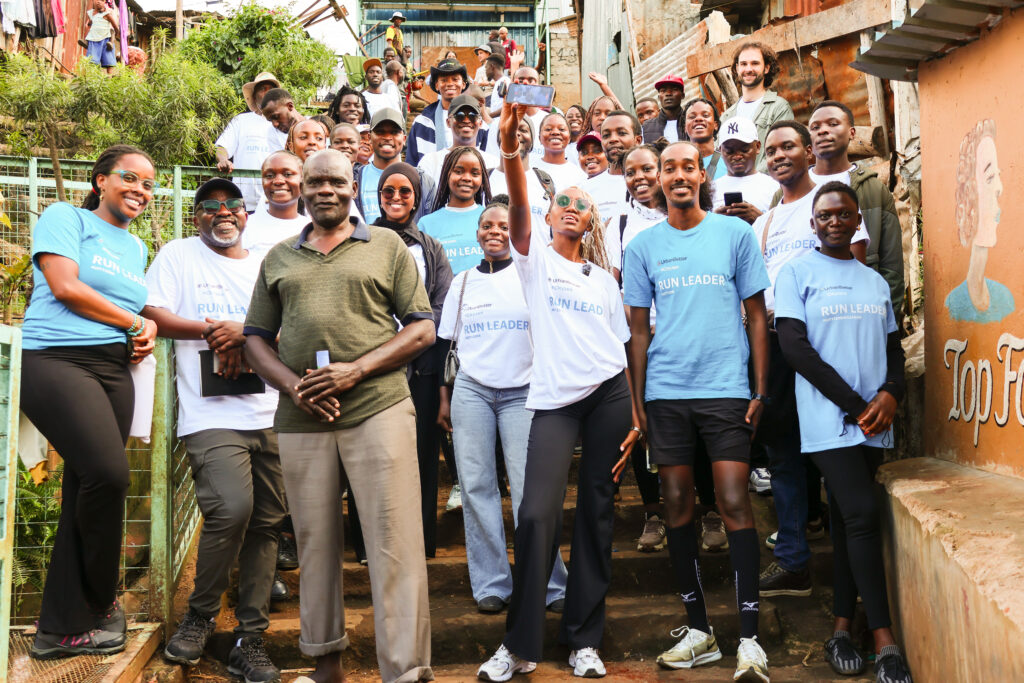
UrbanBetter is a youth-led, data-driven advocacy movement working at the intersection of health, climate, and city design. In Nairobi, it uses simple tools like wearable air sensors, storytelling, and citizen-led campaigns to turn everyday moments like walking and running into powerful tools for change. UrbanBetter’s approach is grounded in movement, both physical and social, and centres the voices of those often left out of city planning.

You may not always see it, but the air we breathe in Nairobi is often unsafe. Every day, walking or commuting through the city, we pass clouds of dust, matatus spitting black smoke, open burning of waste, and roadside cooking fires. We used to think this was just “normal city life.” But once we started carrying air quality sensors during our UrbanBetter runs, the data and the reality hit differently.
The truth is, dirty air isn’t just uncomfortable, it’s dangerous. It causes asthma, heart issues, and other serious health problems, especially for kids, older people, and women who are often exposed to indoor smoke. According to the World Health Organisation, nearly 19,000 people in Kenya die early every year because of air pollution. That number is more than a statistic it represents people in our communities. People we pass every day. People whose stories we carry with us on every run. That’s what keeps us moving.
UrbanBetter puts clean air at the centre of our work. During our runs, we don’t just collect data, we collect stories. We talk to mamas selling groceries, kids walking to school, and boda riders navigating traffic fumes. These conversations remind us that air pollution isn’t about abstract numbers but about real people struggling to breathe.

© Maryanne Kariuki
One moment that stuck with us was during a recent pilot activation in South B. As we ran past an open dumpsite near a food stall, a young girl waved at us and asked what the strange gadget on our chest was. We explained it was measuring air pollution. She simply said, “Oooh… ndio maana madhe hukasirika na kukohoa kila saa.” Her words pierced our hearts. This isn’t just about data, it’s about that little girl’s mother and thousands like her.

Working with UrbanBetter has taught us that advocacy doesn’t have to be loud to be powerful. Sometimes it looks like a small group of us walking through the city, sensors in hand, stopping to note a broken sidewalk or a smoky food stall. Sometimes it looks like handing over a placard that says “Clean Air is a Right” to a 10-year-old who’s never heard of climate change, but knows something doesn’t feel right when her eyes sting on her walk to school.

© Brian Arika
The good news? Things are changing. Nairobi is starting to pay attention. Projects like Breathe Cities are pushing for better policies, cleaner transport, and stronger waste management. Recent studies show that Nairobi’s mean annual PM2.5 concentration is 18.4 μg/m3, which is 3.7 times higher than the WHO annual guideline of 5 μg/m3. The city has started real-time air monitoring and is creating new laws to protect public health. But change isn’t just top-down, it’s from the ground up, too.
As Run Leaders, we move with purpose. We use our runs and walks not just for fitness, but as a form of protest, a way of saying: “We want better.” I still remember feeling my lungs burn as we ran past the industrial area, where PM2.5 levels can exceed WHO safety limits by 400%. We map out both the ugly burning trash, blocked drains and the beautiful tree-lined streets and shaded paths. Our feet tell the story of our city.
And yes, there are hard days. It can be frustrating to feel like progress is slow or policies are ignored. Sometimes I wonder if our small actions matter when faced with such a massive problem. But through UrbanBetter, we’ve found something powerful: a community of people who care, who show up rain or shine, and who believe that Nairobi can be healthier, greener, and fairer for all of us.

© Maryanne Kariuki
The journey toward cleaner air isn’t over. But step by step, run by run, story by story, we’re making Nairobi a city where everyone can breathe a little easier. And on days when the challenge seems too great, I think of that little girl in South B, and I lace up my running shoes again.
Citations
- World Health Organisation. “Air Pollution in Kenya.” WHO Air Quality Database, 2023.
- Nairobi Air Quality Monitoring Network. “Annual Air Quality Report for Nairobi County.” 2024.
- Environmental Research Institute. “Urban Air Pollution Hotspots in East African Cities.” Journal of Urban Health, 2023.